
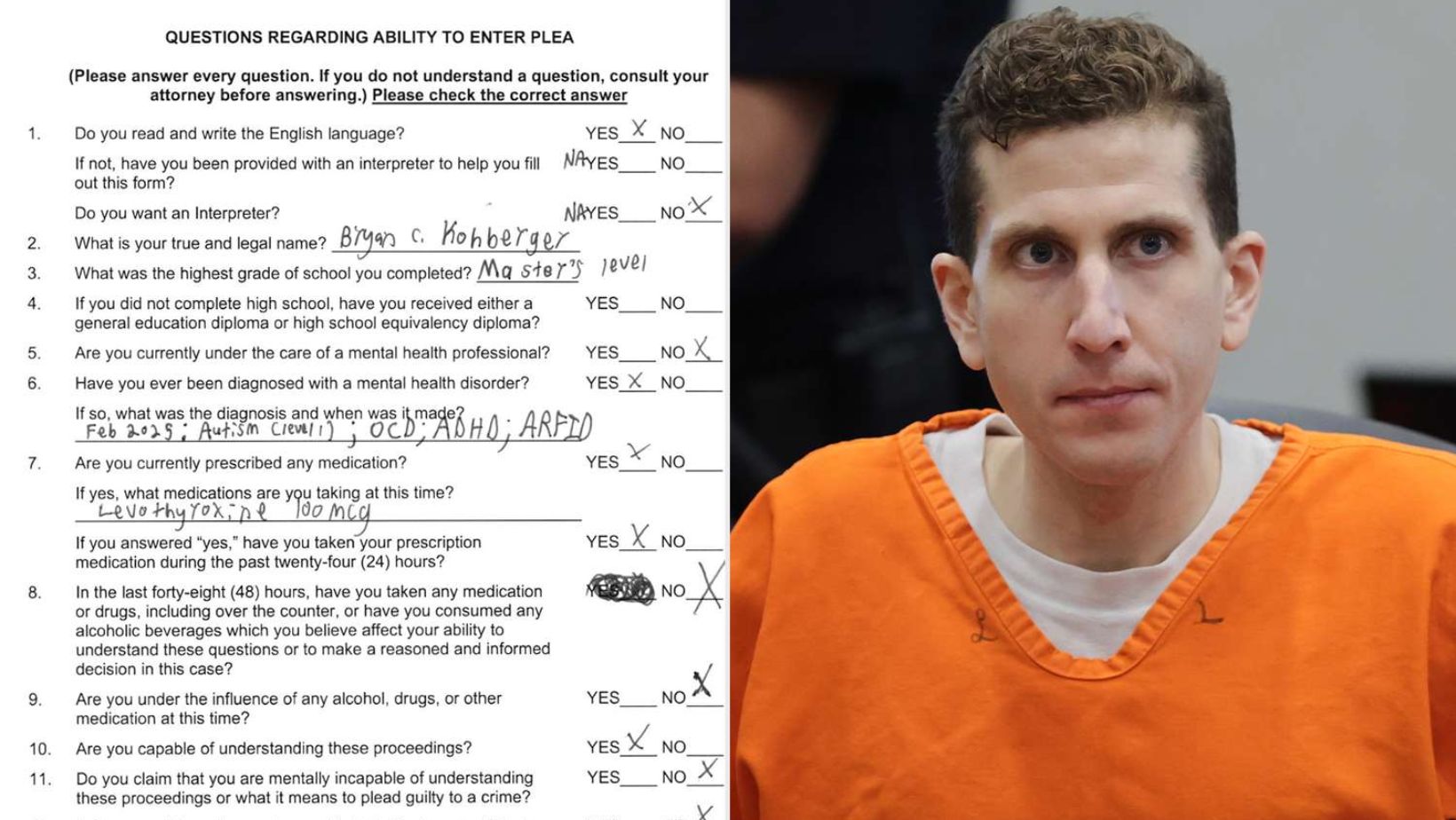

- Kohberger diagnosed with autism, OCD, ADHD, and ARFID in early 2025.
- He denied using mental health to challenge legal competence.
- Hypothyroidism medication was part of his medical profile.
- Visual snow syndrome may have contributed to his psychological distress.
Bryan Kohberger, who was convicted of murdering four University of Idaho students, recently revealed four mental health disorders in a court filing. This disclosure came just months before his guilty plea and life sentencing in July 2025.
The diagnoses provide more insight into his psychological state but do not affect his legal responsibility.

Kohberger’s Diagnoses Include Autism, OCD, ADHD, and ARFID
In a handwritten court document dated June 29, 2025, Kohberger listed his diagnoses from February 2025: autism (level 1), obsessive-compulsive disorder (OCD), attention-deficit/hyperactivity disorder (ADHD), and avoidant/restrictive food intake disorder (ARFID). He mentioned these conditions while stating that he clearly understood the legal proceedings.
Autism level 1 indicates mild symptoms that often do not require daily support. OCD involves recurring unwanted thoughts and repetitive actions, while ADHD impacts attention and focus. ARFID is an eating disorder marked by highly selective eating habits, often due to sensory sensitivities or fears like choking.
Kohberger’s court filing stated:
“Autism (level 1); OCD; ADHD; ARFID.”
New! Bryan Kohberger says in Feb 2025 he had been diagnosed with: autism (level 1), OCD, ADHD and the eating disorder ARFID#idaho4
Source: People pic.twitter.com/I37xLXdvtT— Jay is 4 Justice Podcast (@jayis4justice) September 3, 2025
He Explicitly Denied Using Disorders to Challenge Legal Competence
Kohberger made it clear that his diagnoses did not hinder his understanding of the court process or his admission of guilt. He acknowledged the consequences of his plea, including life imprisonment and financial penalties.
The court filing stressed his awareness of the sentencing outcomes, leaving no doubt about his mental state during the proceedings. This point was important since Idaho does not accept an insanity defense, making his mental health conditions less relevant legally.
Kohberger wrote in the filing:
“The mental health disorders and medication would have no effect on understanding the court proceedings or what it meant to plead guilty to a crime.”
Kohberger Was Also Managing a Thyroid Condition
Besides his mental health disclosures, Kohberger shared that he was taking levothyroxine, a medication for hypothyroidism.
This common endocrine disorder can lead to fatigue and weight changes, but it was not a key point in his legal case. Adding this detail gave a clearer view of his health without swaying the court’s decision.
Visual Snow Syndrome and Past Struggles Resurfaced
Earlier reports noted Kohberger’s history with visual snow syndrome (VSS), a rare neurological condition that causes static-like vision disturbances. In a 2011 online forum, he described a feeling of detachment from reality, stating:
“It is like I am looking at a video game… I am stuck in the depths of my mind.”
This condition affects 2–3% of people worldwide and can occur alongside anxiety and depression. While it is not directly linked to his crimes, it provides context for his overall health challenges.
Also Read: Millie Court Breaks Silence After Liam Reardon Split Confirmation
Last Updated on September 4, 2025 by 247 News Around The World